
Industrial Gas Cooler for Hot Flue Gas Cooling Forced Draft Design
A gas cooler from EASTERN reduces hot process gas temperatures from 1400°C down to 140°C using customized forced draft systems trusted by steel, foundry and ceramic industries worldwide.
Introduction Gas Coolers
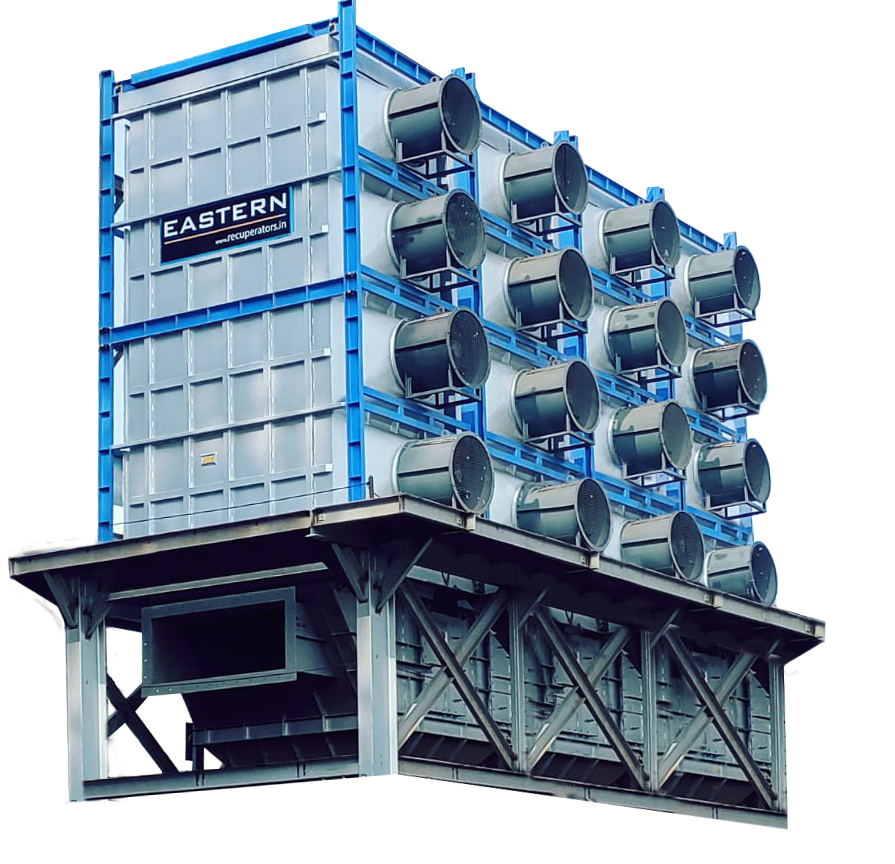
Industrial gas coolers reduce the temperature of hot exhaust gases in industrial processes. They improve efficiency, protect equipment, and reduce energy loss.
In many industries, high-temperature gases are released during operations. As a result, industries can control temperature and improve performance. Unlike wet cooling systems, gas coolers do not increase gas volume because no moisture is added. As a result, the gas remains clean and easy to handle. Gas coolers work with pollution control systems like ESP and bag filters to cool hot, dust-filled gases before cleaning.
Our coolers are cost effective, they have the lowest maintenance cost and are easy to operate. The gas coolers/ forced draft flue coolers are installed in steel melting Arc furnaces, Sponge Iron Plants, Lead Smelters, Incinerators, etc. In addition, our systems can cool gases from extremely high temperatures (up to 1400°C) to safe operating levels. Therefore, they protect downstream equipment and improve efficiency. The cooled gas stays clean and does not get contaminated.
In addition, recovered heat can be used in other processes. Moreover, the system can use process gas, air, or a combination for cooling.
We factory-assemble our forced draft coolers for fast and easy installation. Industries use this system in VOC abatement and similar pollution control processes.
Moreover, gas coolers can replace evaporative cooling systems thereby reducing processed water usage and associated increase in dirty gas volumes. Therefore, with dry cooling, the moisture content in the cooled gas can be controlled as desired. The system does not increase gas volume because it does not add water vapour.
How Does Gas Cooler Work?
A gas cooler is a heat exchange device that reduces the temperature of hot process gases by transferring their heat to a cooling medium. In most cases, the system uses atmospheric air to cool the gas. The gas and air do not mix. As a result, the gas stays clean during the entire process.
Overall, the process works in three straightforward steps:
Step 1 — Hot Gas Enters
Hot flue gas enters the cooler directly from your industrial process – furnace, incinerator, or smelter at inlet temperatures that can reach 1,400°C. EASTERN designs each cooler based on your gas temperature and composition. This ensures better performance from day one.
Step 2 — Heat Transfers Indirectly
The hot gas flows through tube bundles or fin surfaces inside the cooler. In contrast to evaporative systems, cooling air passes on the outside of these surfaces, absorbing heat without ever mixing with the process gas. Furthermore, because no water enters the gas stream, the volume of cooled gas does not increase. This is a significant advantage when sizing downstream bag house or ESP equipment.
Step 3 — Cooled Gas Exits
The cooled gas exits at your specified outlet temperature, typically between 120°C and 200°C, and flows directly to your pollution control equipment. As a consequence, your bag house filters, ESP electrodes, and scrubber internals always operate within their rated temperature range.
In addition, the cooling air absorbs heat, and you can reuse this energy. You can redirect it into your facility as preheated process air or exhaust it safely depending on your plant’s energy recovery needs.
Types of Gas Coolers
There are different types of gas coolers used in industries. Each type is designed based on specific process requirements.
Vertimax — Vertical Gas Cooler
The Vertimax is a vertically oriented forced draft cooler designed for high gas flow rates in plants with limited floor space. Gas flows vertically through the heat exchange surfaces, and cooling fans are arranged around the perimeter. This configuration suits steel plants, sponge iron facilities, and large-scale incinerators.
Hortimax — Horizontal Gas Cooler
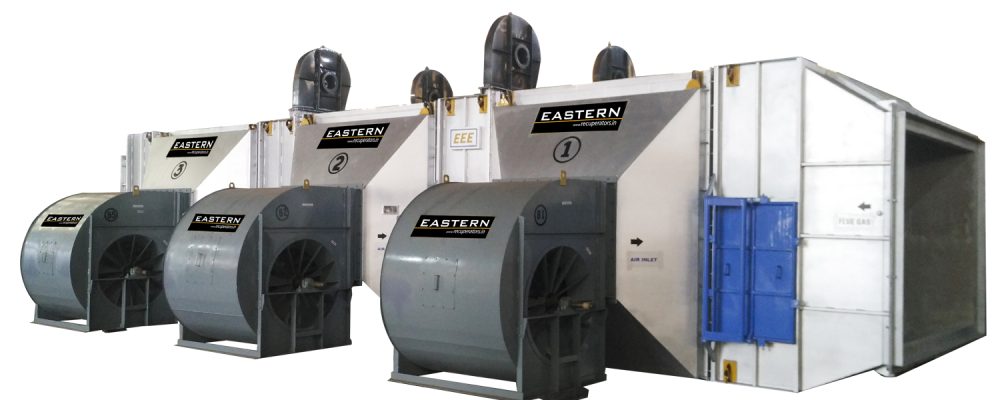
The Hortimax uses a horizontal gas flow arrangement, making it easier to integrate into existing plant layouts with low headroom. It is commonly installed in foundry operations, lead smelters, and ceramic kilns where headroom is restricted.
Recuperative Gas Cooler
The Recuperative type combines cooling with heat recovery. Hot gas passes through a recuperator-style heat exchanger, and the recovered thermal energy preheats combustion air or process air elsewhere in the plant. This configuration reduces fuel consumption and improves overall plant efficiency — making it particularly attractive for ceramic, glass, and forge operations where fuel costs are high.
In addition, all three designs share EASTERN’S core advantages: fully customized sizing, factory pre-assembly for fast site installation, and construction from materials selected for your specific gas composition and temperature.
Gas Cooler Features and Technical Specifications
EASTERN engineers each gas cooler to perform in the most demanding industrial environments. Furthermore, because every unit is custom-designed, the specifications below represent our design envelope — not fixed catalog limits.
| Feature | Details |
|---|---|
| Inlet Gas Temperature | Up to 1,400°C |
| Outlet Gas Temperature | Customized — typically 120°C to 200°C |
| Cooling Medium | Atmospheric air (dry cooling — no water added) |
| Configuration | Forced draft, fan-cooled |
| Construction Materials | Carbon steel, alloy steel, stainless steel — selected for gas composition |
| Assembly | Factory pre-assembled modules |
| Capacity | Customized to your gas flow rate (m³/hr) and temperature targets |
| Certification | ISO 9001:2015 |
Key design highlights:
- Gas and cooling air stay fully separated — zero contamination risk at all operating conditions
- No increase in cooled gas volume, because Eastern uses dry air cooling instead of water injection
- Modular design allows capacity expansion in the future without replacing the entire unit
- Minimal moving parts throughout, which means a low maintenance requirement over the product lifecycle
- Compatible with ESP, bag house, and wet scrubber systems downstream
Eastern does not supply standard off-the-shelf units. Every gas cooler we build is custom-engineered to your plant’s exact requirements.
Benefits of Choosing an EASTERN Gas Cooler
Dry Cooling — No Water, No Contamination
EASTERN’S gas coolers cool process gas without adding a single drop of moisture. As a result, your downstream bag filters and ESP electrodes receive clean, dry gas — which reduces clogging, corrosion, and unplanned maintenance downtime significantly.
Lower Operating Cost Over the Full Lifecycle
Our gas coolers do not require water supply and contain minimal moving parts, operating costs stay low throughout the product’s service life. In addition, our coolers carry one of the lowest maintenance cost profiles available in the Indian market for this class of equipment.
Full Custom Engineering — Built for Your Plant
No two industrial plants are identical. Therefore, EASTERN engineers each gas cooler from scratch to match your exact gas composition, temperature, flow rate, and site constraints. This means you get the right equipment the first time — with no field modifications required after installation.
Fast Site Installation Through Factory Assembly
As a result, EASTERN pre-assembles gas coolers in modular sections at our Kolkata factory. Consequently, site erection takes significantly less time than field-built alternatives — reducing your plant shutdown period and installation cost.
Protects Your Downstream Pollution Control Equipment
Because of this, by delivering gas at the correct temperature to your pollution control devices, our coolers extend the service life of bag house filters, ESP electrodes, and scrubber components. Most importantly, this protection reduces your total cost of ownership across the entire pollution control system — not just the cooler itself.
Energy Recovery With the Recuperative Type
With EASTERN’S Recuperative configuration, the cooling process also recovers usable heat. You can redirect this recovered energy as preheated combustion air to your burners — directly reducing your fuel consumption and improving overall plant efficiency.
Gas Cooler Applications Across Industry
EASTERN’S gas coolers serve some of India’s most demanding industrial environments. Each sector presents unique challenges — different gas temperatures, dust loads, and process chemistries. Our engineers bring direct application experience to every industry we serve.
Steel and Sponge Iron Plants
Arc furnaces, induction furnaces, and direct-reduced iron (DRI) plants generate large volumes of dust-laden flue gas at extreme temperatures. EASTERN’S Vertimax gas coolers are widely installed in steel melting shops to condition flue gas before it enters ESP or bag house cleaning systems. Our coolers handle the variable gas flow rates that are typical in arc furnace operations.
Forging and Foundry
Forging furnaces and foundry cupola furnaces produce hot gases with high particulate loads. In most cases, the Hortimax configuration suits these applications best because it integrates easily into low-headroom plant layouts without requiring structural modifications.
Ceramic and Refractory
Tunnel kilns and periodic kilns operating on solid fuels or gas generate emissions that plants must cool and clean before discharge. The Recuperative Gas Cooler type is the ideal choice here. Not only does it cool the gas, but it also recovers heat to preheat combustion air, cutting fuel bills and improving kiln efficiency simultaneously.
Lead and Non-Ferrous Smelters
Lead and zinc smelting produce highly corrosive flue gases rich in sulfurous and acidic compounds. As a result, EASTERN selects construction materials specifically resistant to these gas compositions, ensuring long service life even in the most aggressive environments.
Industrial Incinerators and Waste-to-Energy Plants
Industrial incinerators must cool post-combustion gas before routing it to pollution control systems. EASTERN routinely installs gas coolers as pre-conditioning units ahead of bag house filters in these applications. In addition, our dry cooling approach prevents moisture from entering the bag house, which is a common cause of filter blinding in incinerator applications.
Glass Manufacturing
Glass furnace operations generate hot exhaust gases that benefit from the Recuperative cooler configuration. EASTERN engineers these units to deliver both emissions control and heat recovery simultaneously, therefore reducing the plant’s overall fuel consumption while maintaining compliance with emission standards.
Why Industries Across Globe Choose EASTERN for Gas Cooling
40+ Years of Specialized Engineering Experience
EASTERN has designed waste heat recovery and gas cooling equipment since the early 1980s. Over the course of four decades, our experience has grown to cover hundreds of installations across steel, foundry, ceramic, and process industries, in India and internationally.
ISO 9001:2015 Certified Manufacturing
Every gas cooler EASTERN builds goes through a rigorous quality management process. This covers engineering design review, material selection, fabrication inspection, pressure testing, and final dispatch checks. As a result, every unit that leaves our Kolkata factory meets the same documented quality standard.
100% Custom — Never Off-the-Shelf
EASTERN does not supply catalog products. Instead, we engineer every cooler specifically for your gas conditions, plant layout, and downstream equipment requirements. Therefore, there are no mismatched specifications, no field rework, and no performance surprises after installation.
Full Project Support From Enquiry to Commissioning
EASTERN supports your project at every stage. Our team provides heat and mass balance calculations, general arrangement drawings, and site supervision support where required. In addition, we supply full documentation, including operation and maintenance manuals, with every unit we deliver.
Proven Performance in Demanding Environments
EASTERN’S gas coolers run continuously in some of India’s toughest industrial plants, steel melting shops, sponge iron facilities, foundry operations, ceramic kilns, and lead smelters across the country. As a result, our design standards reflect real operating experience, not just theoretical calculations.
Frequently Asked Questions About Gas Coolers
What is the difference between a gas cooler and an evaporative cooler?
A gas cooler uses atmospheric air to cool process gas indirectly, the gas and air never mix, and no water enters the gas stream. In contrast, an evaporative cooler injects water directly into the gas to reduce its temperature. Because EASTERN’s gas coolers add no water, the gas volume does not increase, and the gas stays completely dry. As a result, downstream bag house filters and ESPs are protected from moisture-related damage and premature failure.
What inlet temperatures can EASTERN gas coolers handle?
EASTERN designs gas coolers for inlet temperatures up to 1,400°C. Furthermore, the outlet temperature is fully customizable , our engineering team designs the cooler to deliver gas at whatever temperature your downstream pollution control equipment requires, typically between 120°C and 200°C.
How do I know what size gas cooler I need?
Sizing depends on three main inputs: your inlet gas temperature, your required outlet temperature, and your volumetric gas flow rate in m³/hr. EASTERN engineering team performs a full thermal calculation based on these parameters. In addition, you can use our online Recuperator Calculator on this website as a starting point before you speak with our team.
Can I use a gas cooler with my existing bag house or ESP?
Yes. Gas coolers are specifically designed as pre-conditioning equipment for bag houses, ESPs, and wet scrubbers. EASTERN designs each cooler to deliver gas at exactly the temperature your downstream equipment is rated for. Consequently, your existing pollution control equipment continues to operate within its design envelope after the cooler is installed.
How long does installation take?
EASTERN pre-assembles our gas coolers in modules at our factory, site erection is significantly faster than field-built alternatives. Lead time from order confirmation to delivery typically ranges from 8 to 16 weeks, depending on cooler size. Your site team then erects the pre-assembled modules, which reduces the installation period considerably.
Does EASTERN supply gas coolers for export?
Yes. EASTERN supplies equipment to international customers. Our ISO 9001:2015 certification, engineering documentation package, and manufacturing standards all support international project requirements. Furthermore, we have experience working with clients across South Asia, the Middle East, and Southeast Asia.
What ongoing maintenance does a gas cooler require?
Gas coolers have a minimal maintenance requirement compared to most other industrial heat exchange equipment. Periodic inspection of tube surfaces, cooling fan bearings, and access door seals is recommended. EASTERN supplies a complete operation and maintenance manual with every unit, so your plant team has clear, documented procedures from day one.
Get the Right Gas Cooling Solution
Choosing the right industrial gas cooler improves efficiency and reduces energy loss.
Talk to our experts today to find the best solution for your plant.