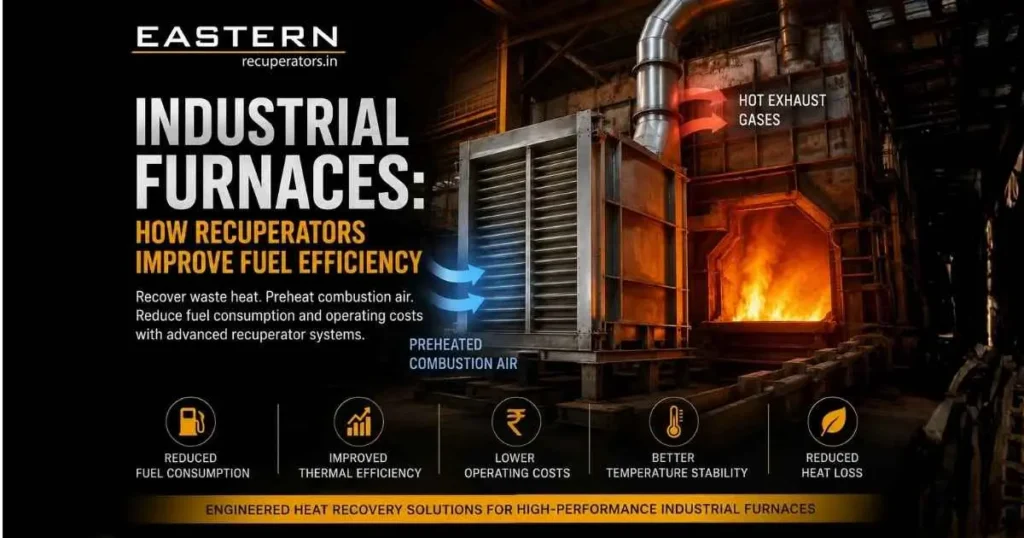
Industrial furnaces use large amounts of fuel during thermal processing. Recuperators improve furnace efficiency by recovering exhaust heat and using it to preheat combustion air, reducing fuel consumption and operating costs.
One of the biggest users of fuel in manufacturing settings is industrial furnaces, and thus heat recovery is one of the most pivotal efficiency strategies in contemporary thermal systems. In operations that use furnaces, exhaust gases carry away large amounts of heat, raising fuel consumption and operating expenses. It is in this that recuperators are important since they can recover waste heat and convert it into useful thermal energy.
Consequently, plant heads, furnace designers, and industrial engineers must understand how recuperators function to enhance fuel efficiency and ensure consistent output.
This guide describes the usefulness of recuperators in furnace systems and explains why they have become an essential component of industrial engineering today.
What Is Industrial Furnace?
To comprehend recuperators, it is essential to answer the question, what is industrial furnace?
An industrial furnace is a high-temperature thermal processing system used to heat, melt, forge, anneal, or treat materials. These systems operate at controlled temperatures depending on process requirements.
In contrast to domestic heating systems, industrial furnaces run continuously or in batches and consume large amounts of fuel or electricity.
The steel, ceramics, glass, foundry, and chemical industries rely heavily on furnace systems. According to the U.S. Department of Energy, industrial heat recovery can cut energy use by up to 50%.
As a result, the furnaces’ efficiency directly determines profitability.
What Is a Recuperator in Furnace Systems?
A recuperator is a heat recovery unit installed directly in the exhaust stream of furnace systems.
In essence, its purpose is simple. Take heat out of exhaust flue gas and redirect the heat to incoming combustion air.
This recaptured heat reduces the load on the burner.
In effect, the furnace reaches the same production temperature while using less fuel. Furthermore, this efficiency improvement generates significant long-run cost savings in high-temperature industrial furnaces.
This renders recuperators as viable investment as opposed to an upgrading option.
How Recuperators Work in Industrial Furnaces
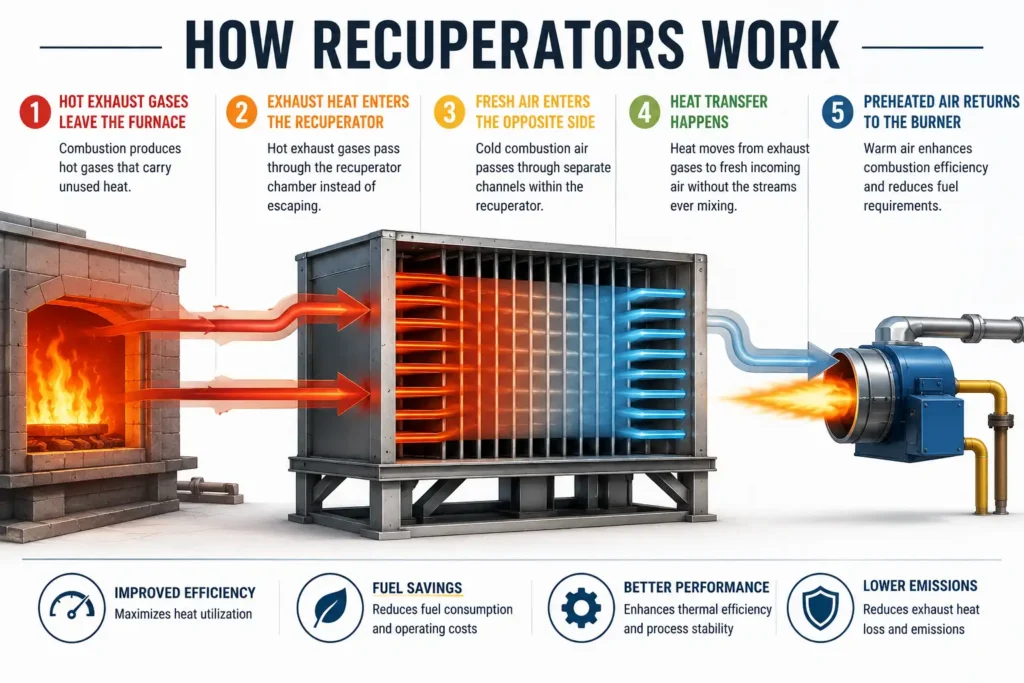
Specifically, understanding this working process helps visualize how heat recovery improves furnace efficiency.
Step 1: Hot Exhaust Gases Leave the Furnace
Combustion produces hot gases that flow directly toward the exhaust.
In fact, these gases carry large amounts of thermal energy that combustion never fully uses.
Step 2: Exhaust Heat Enters the Recuperator
Instead of escaping into the atmosphere, these hot gases pass through the recuperator chamber.
Step 3: Fresh Air Enters the Opposite Side
Meanwhile, cold combustion air passes through separate channels within the recuperator.
Step 4: Heat Transfer Happens
As a result, heat moves from exhaust gases to fresh incoming air without the streams ever mixing.
Step 5: Preheated Air Returns to the Burner
Consequently, this warm air enhances combustion efficiency and minimizes fuel requirements.
This is the cycle that occurs during the functioning of the furnace.
Types of Industrial Furnaces That Use Recuperators
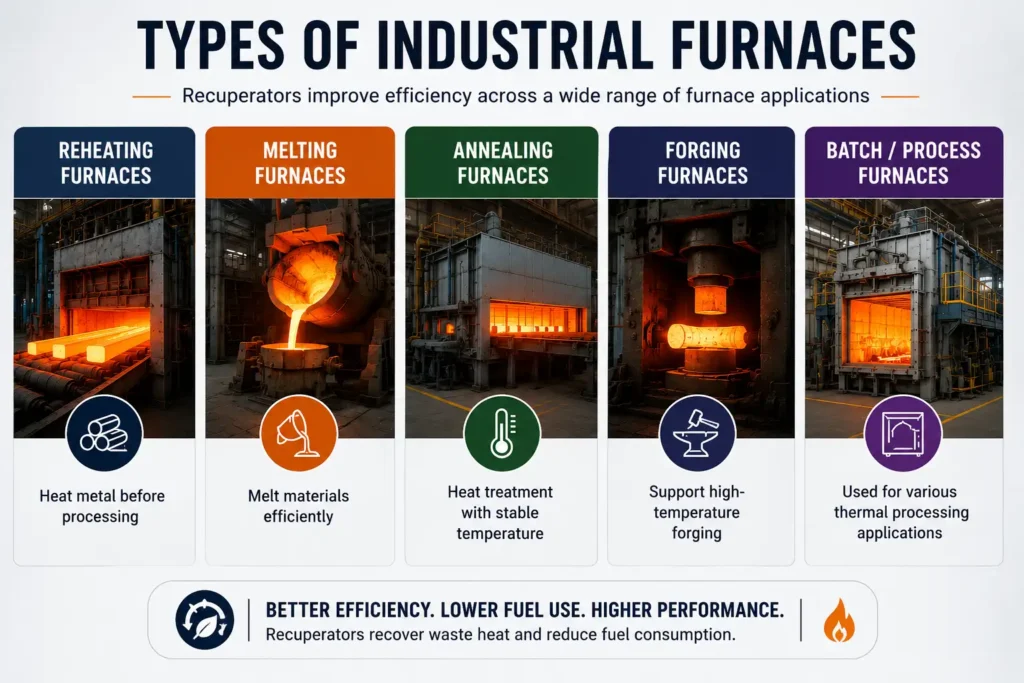
Recuperator systems are advantageous in various types of industrial furnaces based on the process temperature and fuel consumption.
Reheating Furnaces
Steel mills use reheating furnaces to heat billets, slabs, and rolls before processing. Recuperators aid in saving fuel during continuous operations.
Employed in glass production and in foundries. Heat recovery enhances melting efficiency across these operations.
Annealing Furnaces
Used for heat treatment processes. Constant temperature helps in the quality of the product.
Forging at high temperatures needs good combustion. Recuperators directly support fuel optimization in high-temperature forging operations.
Indeed, all these industrial furnaces are heavy fuel consumers making heat recovery especially valuable.
Benefits of Recuperators in Industrial Furnaces
Additionally, recuperators create measurable operational benefits across all these applications.
- Reduced Fuel Consumption
The waste exhaust heat is used to preheat the combustion air by recuperators which reduces combustion burner fuel requirements and total fuel burnt in the furnace.
- Improved Thermal Efficiency
Specifically, recuperators reuse lost thermal energy to enhance the thermal efficiency of the entire furnace system.
- Lower Operating Costs
The decreased fuel consumption directly translates into lower operational costs, which enable industries to control the production cost, and enhance profitability during the long run furnace operations.
- Better Temperature Stability
In addition, preheated combustion air creates more stable flame conditions, improving temperature uniformity and overall production quality.
- Reduced Heat Loss
Recuperators ensure that exhaust heat is not lost, reducing the amount of wasted energy and enhancing the efficiency of the entire heat management of the furnace systems.
How to Select the Right Recuperator for Industrial Furnaces?
The choice of the appropriate system must be done technically.
- Furnace Temperature Range
Increased exhaust temperatures enhance the potential of heat recovery.
- Fuel Type
Hear transfer design is influenced by gas, oil and other fuels.
- Space Availability
Recuperator design choices are dependent on installation space.
- Exhaust Gas Composition
Material selection is affected by dust and corrosive gases.
- Production Load
Heat recovery systems are often more beneficial to continuous operations. Ultimately, the correct fit enhances both performance and equipment longevity.
Conclusion
Recuperators are important in enhancing efficiency of industrial furnaces by utilizing waste heat into combustion energy.
Specifically, for industries operating high-temperature systems, this means reduced fuel usage, enhanced thermal efficiency, and greater cost control.
Knowledge of the incorporation of recuperators into furnace systems assists decision-makers to streamline operations and enhance profitability in the long run.
EASTERN Recuperators is an engineering & design company that deals with cutting edge heat recovery systems that are needed in extreme industrial furnace. Our solutions are engineering-based to ensure that industries make the best use of fuel and better thermal performance using precision-built recuperator systems.
Frequently Asked Questions (FAQ)
What are industrial furnaces used for?
Heating, melting, forging, annealing and thermal processing of steel, ceramics, glass and chemicals industries are all carried out in industrial furnace.
What is industrial furnace heat recovery?
Industrial furnace heat recovery entails the recovery of waste heat through exhaust gases and recycling it to enhance fuel efficiency.
How do recuperators improve industrial furnaces?
Recuperators reclaim exhaust energy and pre-heat combustion air, saving fuel and enhancing thermal efficiency.
What types of industrial furnaces use recuperators?
The recuperators are frequently used in heating furnaces, melting furnaces, annealing furnaces, and forging furnaces.
Why is energy saving important in furnace systems?
Energy conservation will decrease the cost of fuels, emission levels and the overall performance of the thermal processing systems.