
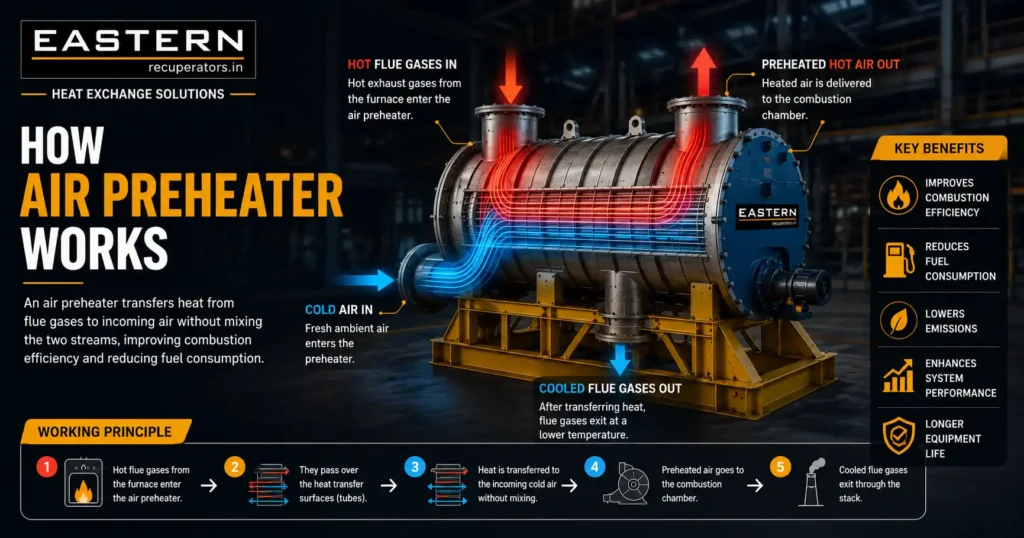
Understanding how air preheater works is essential for any industrial plant focused on fuel efficiency and thermal performance.
In sectors where profitability depends on fuel costs and thermal efficiency, however, omitting how preheating systems work can lead to significant energy loss. In reality, a large number of plants continue to run at less than optimum capacity due to improper use of combustion air.
Knowing precisely how air preheater works helps decision-makers maximize operational efficiency, minimize fuel use, and enhance system reliability.
What is an Air Preheater and Why Does It Matters?
An air preheater is a heat exchanger that transfers heat from flue gases to incoming air, which then enters the combustion chamber. It is through this process that the temperature of the combustion air is raised.
The core feature is simple yet effective. Preheating reduces the fuel the system needs to reach combustion temperature. Additionally, this translates into efficiency and reduced operation costs in industrial boilers, furnaces, and thermal systems.
The U.S. Department of Energy claims that improved heat recovery in industrial systems can reduce energy use and emissions by 20% and 50%, respectively.
How Air Preheater Works: The Operating Principle Explained
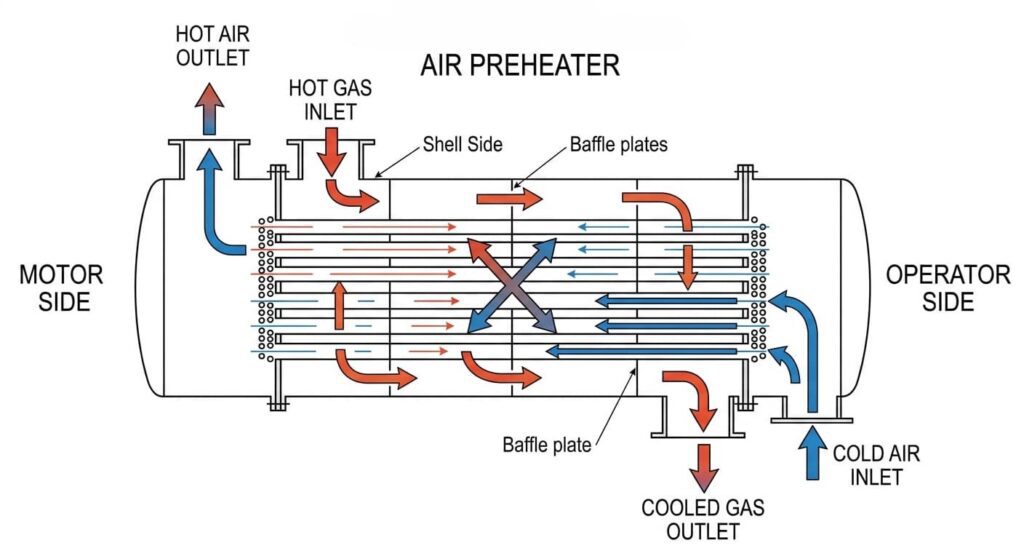
The principle of an air preheater is the heat exchange between two air streams that do not mix directly. Specifically, exhaust gases exiting the combustion chamber carry a large amount of unused thermal energy. Rather than expelling this heat into the atmosphere, an air preheater captures it and sends it to the incoming cold air.
On one side of the heat exchanger, hot exhaust gases move. On the other side, fresh air flows in the opposite direction. The surface then conducts this heat between the two streams. The system then feeds hot air into the combustion chamber.
At this point, preheating the combustion air is important. As a result, higher air temperatures enhance fuel ignition, flame stability, and overall combustion efficiency.
Key Components of Air Preheater System
Knowing these components is essential for both decision-making and maintenance planning.
- Heat Transfer Surface: This is the heart of the system where heat exchange occurs. It is designed to maximize thermal contact between flue gases and air.
- Air Duct System: Pipes that lead fresh air to the preheater and hot air to the combustion chamber.
- Flue Gas Path: The path that hot exhaust gases can travel enables them to transfer heat and leave the system.
- Sealing Arrangements: Proper sealing prevents air and flue gas from mixing, keeping the system efficient.
Types of Air Preheaters Used in Industry
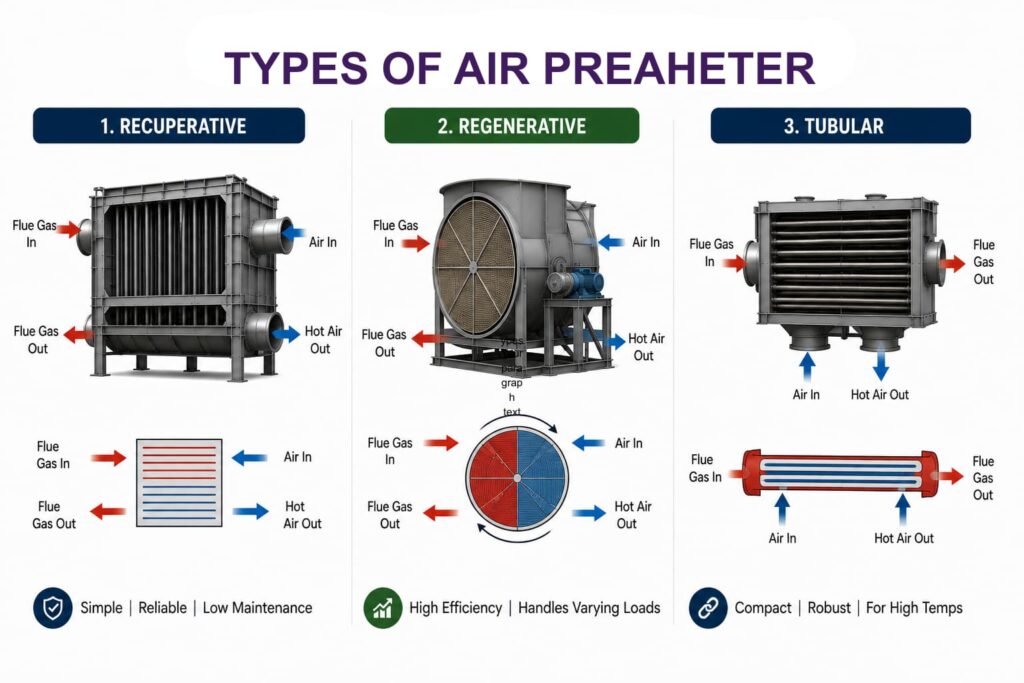
Air preheaters are used in various industries, depending on the application and operating conditions.
Recuperative Air Preheaters
These use fixed surfaces for heat transfer. The air and flue gases move simultaneously on opposite sides of the surface.
Regenerative Air Preheaters
They use a rotating heat storage element that captures heat from the flue gases and conveys it to incoming air.
Tubular Air Preheaters
These are tube bundles in which air flows through the tubes and flue gases flow out. They are each designed to maximize air preheater operation according to the system’s needs.
How Does Combustion Air Preheat Improve Efficiency?
The principle of preheating combustion air directly impacts fuel consumption and efficiency.
As a result, the higher the air temperature in the combustion chamber, the less fuel is required to achieve the necessary flame temperature. This enhances thermal efficiency.
Furthermore, preheated air mixes more effectively with fuel, leading to complete combustion. This minimizes the wastage of unburned fuel and reduces emissions.
Indeed, even a slight efficiency gain in large-scale operations leads to considerable long-term cost savings.
Benefits of Air Preheater in Industrial Systems
Air preheaters are not just efficiency tools they are complete energy management resources.
- Reduced Fuel Consumption: Preexisting air saves on the energy needed to combust.
- Improved Thermal Efficiency: More efficient use of heat results in improved system performance.
- Lower Emissions: Combustion that is efficient limits the pollution and environmental impact.
- Enhanced Equipment Life: Constant burning conditions eliminate strain on equipment.
- Savings in Cost in the Long Run: Energy conservation will lead to financial benefit in the long run.
Common Challenges in Air Preheater Operation
However, air preheaters underperform when design or maintenance is inadequate.
- Fouling and Dust Accumulation: Accretions on the surfaces of heat exchangers lower efficiency.
- Leakage Issues: Leakage of air or gas affects heat transfer and reduces efficiency.
- Corrosion Risks: Flue gases degrade materials over time due to exposure to flue gases.
- Improper Design Selection: Choosing the wrong preheater type creates system-wide inefficiencies.
To overcome these problems, design the system correctly from the start and consult experienced engineers.
Why Correct Design Matters More Than Installation?
Consequently, most industrial systems do not perform as designed due to poor design choices.
The principle of air preheater functionality is the same, and the performance is affected by the extent of optimization of the system in a particular operating environment.
The design should take into account factors such as temperature range, fuel type, available space, and load changes. A generic solution will hardly give the best results.
This is where experienced manufacturers make the difference.
Conclusion
Knowing how air preheater works goes beyond understanding a technical concept. It is one of the major factors in industry efficiency, cost management, and sustainability.
Knowledge of heat recovery operation and its proper application can improve plant performance. The distinction between optimal and average systems usually lies in the quality of design and execution.
When industries need to become more efficient and reduce their operating costs, they have to cooperate with manufacturers with long-term experience.
EASTERN Recuperators provides industry-specific heat-recovery solutions. Our competence in planning and producing high-performance systems ensures the best performance in any application.
Frequently Asked Questions (FAQs)
What is the main purpose of an air preheater?
An air preheater works by capturing heat from flue gases and transferring it to incoming combustion air, directly improving fuel efficiency.
How does combustion air preheat improve performance?
Warmer combustion air ignites fuel faster, burns it more completely, and reduces overall energy consumption.
What industries use air preheaters?
Power plants, steel mills, cement plants, and chemical processing facilities all rely on air preheaters for thermal efficiency.
What are the common types of air preheaters?
The most common ones are recuperative, regenerative, and tubular air preheaters.
Why is air preheater design important?
Proper design ensures maximum heat recovery, system efficiency, and long-term durability specific to your operating conditions.
When you intend to upgrade or install an air preheater, contact us today.